As our technological and scientific capabilities progress, it is inevitable that nanotechnology will play a greater role in our everyday lives. Already different types of computer parts, medical technologies, and countless other inventions are a vital part of our societies. As mentioned in Professor Vesna’s article, “Nanotechnology works at a scale where biotech, chemistry, physics, electrical and mechanical engineering converge, and thus has real potential to impact every aspect of our lives.”

Nanotechnology explores the possibilities of science and art and the molecular and atomic level based off of the substance’s structure.
A popular catch phrase, “seeing is believing” is a rather difficult idea to apply to nanotechnology. As National Geographic states, “how do you make something so miniscule and abstract appear real to the ordinary eye?” For many people, it is hard to fathom the breakdown of molecules and atoms in general, much less on a scientific and technological scale.
But what if we use art to make nanotechnology a more concrete and easily grasped idea?
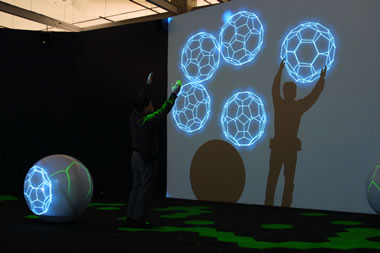
In 2004, LACMA exhibited “NANO,” an interactive display on nanotechnology. From creating a Quantum physics tunnel, to making life-sized buckyballs which recreate the structure of certain types of nano particles, the “NANO” exhibit makes nanotechnology more easily envisioned, if not more accessible. Flash forward ten years, and we are currently surrounded by the prospects of nanotechnology. From advanced microchips, to materials to enhance clothing, to the possibility of self-assembling skin grafts, nanotechnology’s prevalence makes it essential to incorporate creative design to make it both functional and fathomable.

LACMA’s “NANO” exhibit provided interactive experiences with nanotechnology, such as the buckyball exhibit pictured here.
We often do not consider extremely scientific processes and innovations to be artistic, yet when looking at images on the nano-scale, we are overcome by their unique beauty. Cris Orfrescu’s “NanoArt” images expose the astounding beauty that previously only a handful of scientists had ever see. Through artistic representation, such as that of “NANO” at LACMA, or through the images we see of nano-particles in “NanoArt”, it is possible to view the way in which art and design influence, and even create, our sense of understanding of scientific technologies. This idea of art improving our understanding of science is important to acknowledge as society progresses and it seems as though science and art are becoming increasingly separated; rather, we should view art as a way to understanding science, and science as a creator of art.

Orfrescu’s “NanoArt” displays the beauty of nanotechnology.
References:
Cortado, Rhea. “LACMA exhbit brigs together science, art.” Daily Bruin. 11 February 2004. Web. http://dailybruin.com/2004/02/11/lacma-exhibit-brings-together/
Gimzewski, Jim; Vesna, Victoria. “The Nanomeme Syndrome: Blurring of fact & fiction in the construction of a new science.” 26 January 2004. Web. http://citeseerx.ist.psu.edu/viewdoc/download;jsessionid=0AF1EFEE1A90856EC5DB09D1E5AA8C79?doi=10.1.1.127.8516&rep=rep1&type=pdf
Johnson, Reed. “A quantum leap.” Los Angeles Times. 22 December 2003. Web. http://articles.latimes.com/2003/dec/22/entertainment/et-johnson22
Lovgren, Stefan. “Can Art Make Nanotechnology Easier to Understand?” National Geographic. 23 December 2003. Web http://news.nationalgeographic.com/news/2003/12/1223_031223_nanotechnology.html
“Nanotechnology Products.” National Nanotechnology Infrastructure Network. 2015. Web.http://www.nnin.org/news-events/spotlights/nanotechnology-products

![http://www.innovationintextiles.com/uploads/3940/dreamstime_xs_17092455[1].jpg](http://www.innovationintextiles.com/uploads/3940/dreamstime_xs_17092455%5B1%5D.jpg)
Hi Kathleen! I enjoyed reading your blog. its crazy to think that nanotechnology and nanoparticles are used in pretty much everything today. While it is relatively new in modern science, it has been used for hundreds of years and can be found on medieval glass windows and pottery. I wish that LACMA still had the exhibition on nanotechnology because then it would be perfect since were learning about it right now.
ReplyDelete