Wednesday, June 3, 2015

Event 3: Natural History Museum of Los Angeles County

One of the most fascinating museums in Los Angeles, the Natural History Museum of Los Angeles County has always been one of my favorites. Perhaps the most time-honored and cherished parts of the museum are the Dioramas. These incredibly life-like, picturesque scenes include gorgeous painted backdrops, sculpted rocks, trees, and other scenery, and of course, taxidermic animal specimen. The Museum has housed a full-time diorama program and display since the 1920s, and audiences of all ages continue to enjoy their beauty. Successful in providing viewers with a close up experience with animals in recreations of the natural habitats in which they were found, these dioramas proved essential in promoting species conservation, as many large mammals had become highly endangered beginning in the 1920s and onward.

The African savannah, complete with a painted backdrop, 3D natural features, and taxidermic animals.

The Dioramas feature a variety of animals and habitats from across the globe. The Natural History museum describes taxidermy as an art, stating that it is a commonly misunderstood medium. Simply put, the taxidermic process includes sculpting clay over an animal’s skeleton, and then stretching the skin over this lightweight mannequin. This process requires great artistic skill, as it is necessary to have an in-depth knowledge of the animal specimen’s anatomy combines with the ability to sculpt well. 
Dad enjoying the buffalo diorama.
Artistic design and technological use play a large role in creating these dioramas. Artistic placement of specimens, recreating habitat scenes, and developing ways in which to make the dioramas seem realistic require a degree of technological innovation. Plaster molds, texture patterns, and heat-pressed plastic combine to make a single leaf; clay, paint, and liquefied plaster create a large boulder. In viewing these dioramas, I was able to observe how art and technology are both vital parts to creating an artwork that transports the viewer to an entirely different world and time. 

What struck me the most about these dioramas was their ability to convey such a strong message about biodiversity and the importance of habitat and species conservation. For the first time, I was able to appreciate the way in which art combines with scientific knowledge in order to strongly express the necessity for both in order to better understand our changing world. These dioramas managed to reinforce one of my favorite concepts of DESMA 9: that the combination of art and science makes both areas infinitely more powerful when unified as a single culture. The dioramas at the Natural History Museum were for me a reminder or the beauty of the natural world, and how we must work to protect the life and biodiversity that is present in all habitats across the Earth.
This image depicts the edge of the African savannah diorama, with the walls of the museum visible behind it, effectively making the diorama seem accessible to the museum visitors.


The author and family enjoying a day at the Natural History Museum (taken in front of the entrance path). 


For fascinating words from diorama artists and historians from the Natural History museum and the process of creating these works of art, check out: https://www.youtube.com/watch?v=f3WYnNV8Yic&list=SP37FA960FC8DA9259&index=11

Monday, June 1, 2015

Event Two: The Getty Center

Upon arriving at The Getty Center, it is easy to appreciate the beauty it contains. This beauty is evident not only in the magnificent works of art it houses, but also in the structure and design of the museum itself. Perhaps the most astounding feature of The Getty is The Central Garden, completed in 1997 by artist Robert Irwin. The 134,000 square-foot design features over 500 varieties of plants, and contains a natural ravine and several areas of grouped plants, such as the cactus garden. From above, the center hedges create a pattern that repeats “G” and “C” for Getty Center, as explained by a helpful tour guide. Looking at the beauty of the landscaping, it is easy to see why The Central Garden is a favorite spot among museum visitors

Overlook of The Central Gardens, with ariel views of the many different types of plants

The Central Gardens offer visitors with a unique interaction with art and nature. Visitors are invited to walk through the foliage and observe nature in action; it is possible to see small insects roaming around the flowers, to appreciate the beauty of different species of plants, and to observe the water feature and natural ravine. In addition, this unique design space offers guests the option of relaxing on the grass with a picnic lunch, all the while surrounded by the white marble of The Getty Center buildings and the brilliant green of The Central Gardens. The Central Gardens remind visitors of their interactions with both art and nature, and how these interaction become cherished and important features of our everyday lives.

Visitors of The Central Garden enjoy the beauty of The Central Gardens, which promote interaction with nature and artistic design.

But The Central Gardens are much more than a picturesque feature of The Getty Center. The gardens incorporate artistic design with environmental ideas. The cactus garden, for example, proves to be environmentally sound as the plants do not require much water. Many other California native plants make The Central Gardens environmentally friendly and can be sustained in the California climate. In an effort to be an example for water conservation, all water features in The Central Gardens have been turned off, declaring to visitors a message of water consumption mindfulness in the face of the California drought. The Central Gardens at The Getty Center helped me better understand the application of math to art, as features of the gardens, such as the central hedges or the spaces allotted for walkways and garden boxes, require careful mathematical planning in order to create a work of art. Additionally, the idea of two cultures is present in The Central Gardens; by combining aspects of environmental science and artistic design, it is evident that these gardens were successful in conveying ideas concerning science and art to the visitors who enjoy the outdoor area. The Central Gardens definitely influenced me in designing my final project: by being able to observe the way in which an artist made nature harmonious with man-made structures, I found inspiration for creating a project which would apply this concept to a variety of aspects of human society. The Central Gardens are a shining example of sustainability and promoting artistic design in nature.


The author at The Getty Center in front of a map and information about the events of the day.

Saturday, May 30, 2015

Week 9: Space and Art

When on October 4, 1957 the Soviet Union launched Sputnik I, life as was previously known changed forever. From that moment on, the development of space technologies spread like wildfire, inciting a so-called Space Race between the United States and the Soviet Union. In this real life drama, competition between the two countries was fierce: one nation would develop an amazing new technology, and in response the other would produce a technology even more astounding. The tensions during the Cold War fueled this Space Race, and led to greater development of outer-space technology faster than any other previous space research periods. 

Sputnik’s influence upon the Cold War and space technologies had a profound effect on shaping aerospace development.

This led the United States to invest more money into education and placed more emphasis on math and science in schools. The growing interest and emphasis in space technology shaped both American society and art culture. Throughout events such as sending a chimpanzee to space, the failure of the Challenger launch, the moon landing, and various other milestones in both US and international space development, space technology and the cosmos captured the attention of citizens and had a subsequent effect on popular culture. Art now began to incorporate ideas of space and technology; concepts which had been previously nonexistent were now visible manifestations. As Petkovic states, “The moon and outer space have long symbolized mystery, romance, adventure, escapism, the fears and seduction of the unknown.”

Artistic representation of space, such as this Normal Rockwell image, romanticized outer space and further fueled human fascination with the cosmos.

This fascination with outer space manifested itself in various forms of art. In television, we see cartoon representations of space in “The Jetsons” and of galactic exploration and extraterrestrial life in classic movies and shows such as “Star Wars” and “Star Trek.” Artistic design in architecture and entertainment was prominent in Disneyland’s Tomorrowland, as the 1960s saw the opening of rides such as “Adventure Thru Inner Space” and “Flight to the Moon.” Countless book series such as Tom Swifty engaged readers in outer space adventures, and the science fiction genre exploded with new works. Various areas of artistic exhibition, ranging from paintings to sculptures, to music and comic books, greatly reflected the synthesis of art and science, allowing this age of the fascination with space exploration to be preserved in popular culture through different artistic mediums. Not only did developments in space exploration better our scientific societies, but it also bettered our artistic society, successfully blending science and art into a single culture.


Examples of various space-influenced manifestations in 20th century pop culture.


References:
Garber, Steve. “Sputnik and the Dawn of the Space Age.” NASA. Web. 10 October 2007.http://history.nasa.gov/sputnik/

Franklin, H. Bruce. “Science Fiction: The Early History.” Andromeda. Web. http://andromeda.rutgers.edu/~hbf/sfhist.html

NASA. “NASA art remembers 50 years of space exploration.” NASA. Web. 26 May 2011. http://www.newscientist.com/gallery/nasa-art-remembers-50-years-of-space-exploration/8

Petkovic, John. “Moon landing, outer space have long inspired pop culture.” Cleveland. Web. 19 July 2009. http://www.cleveland.com/entertainment/index.ssf/2009/07/moon_landing_outer_space_have.html


Vesna, Victoria. “Space Exploration + Art part 2.” Youtube. Web. 29 July 2013. https://www.youtube.com/watch?v=hLZMDpoP-u0


Friday, May 22, 2015

Week 8: Nanotechnology and Art

As our technological and scientific capabilities progress, it is inevitable that nanotechnology will play a greater role in our everyday lives. Already different types of computer parts, medical technologies, and countless other inventions are a vital part of our societies. As mentioned in Professor Vesna’s article, “Nanotechnology works at a scale where biotech, chemistry, physics, electrical and mechanical engineering converge, and thus has real potential to impact every aspect of our lives.” 
Nanotechnology explores the possibilities of science and art and the molecular and atomic level based off of the substance’s structure.


A popular catch phrase, “seeing is believing” is a rather difficult idea to apply to nanotechnology. As National Geographic states, “how do you make something so miniscule and abstract appear real to the ordinary eye?” For many people, it is hard to fathom the breakdown of molecules and atoms in general, much less on a scientific and technological scale. 

But what if we use art to make nanotechnology a more concrete and easily grasped idea?

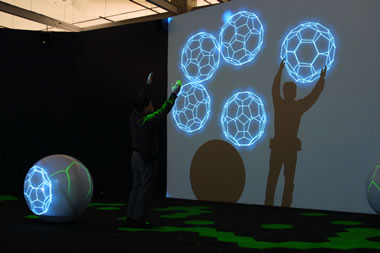
In 2004, LACMA exhibited “NANO,” an interactive display on nanotechnology. From creating a Quantum physics tunnel, to making life-sized buckyballs which recreate the structure of certain types of nano particles, the “NANO” exhibit makes nanotechnology more easily envisioned, if not more accessible. Flash forward ten years, and we are currently surrounded by the prospects of nanotechnology. From advanced microchips, to materials to enhance clothing, to the possibility of self-assembling skin grafts, nanotechnology’s prevalence makes it essential to incorporate creative design to make it both functional and fathomable. 
LACMA’s “NANO” exhibit provided interactive experiences with nanotechnology, such as the buckyball exhibit pictured here.

We often do not consider extremely scientific processes and innovations to be artistic, yet when looking at images on the nano-scale, we are overcome by their unique beauty. Cris Orfrescu’s “NanoArt” images expose the astounding beauty that previously only a handful of scientists had ever see. Through artistic representation, such as that of “NANO” at LACMA, or through the images we see of nano-particles in “NanoArt”, it is possible to view the way in which art and design influence, and even create, our sense of understanding of scientific technologies. This idea of art improving our understanding of science is important to acknowledge as society progresses and it seems as though science and art are becoming increasingly separated; rather, we should view art as a way to understanding science, and science as a creator of art. 
Orfrescu’s “NanoArt” displays the beauty of nanotechnology.

References:
Cortado, Rhea. “LACMA exhbit brigs together science, art.” Daily Bruin. 11 February 2004. Web. http://dailybruin.com/2004/02/11/lacma-exhibit-brings-together/

Gimzewski, Jim; Vesna, Victoria. “The Nanomeme Syndrome: Blurring of fact & fiction in the construction of a new science.” 26 January 2004. Web. http://citeseerx.ist.psu.edu/viewdoc/download;jsessionid=0AF1EFEE1A90856EC5DB09D1E5AA8C79?doi=10.1.1.127.8516&rep=rep1&type=pdf

Johnson, Reed. “A quantum leap.” Los Angeles Times. 22 December 2003. Web. http://articles.latimes.com/2003/dec/22/entertainment/et-johnson22

Lovgren, Stefan. “Can Art Make Nanotechnology Easier to Understand?” National Geographic. 23 December 2003. Web http://news.nationalgeographic.com/news/2003/12/1223_031223_nanotechnology.html

“Nanotechnology Products.” National Nanotechnology Infrastructure Network. 2015. Web.http://www.nnin.org/news-events/spotlights/nanotechnology-products


Friday, May 15, 2015

Week 7: Neurosci and Art

“Since to be wholly of the present means to be fully conscious of one’s existence as a man, it requires the most intensive and extensive consciousness, with a minimum of unconsciousness,” so states Carl Jung, renowned psychiatrist who had a deep effect on society through his founding of analytical psychology. Consciousness is defined as “awareness of something for what it is; internal knowledge.” However, the state of consciousness is subjective; we cannot define this state in a particular way, nor can we determine a correct way to achieve consciousness. To many, consciousness means possessing a clear mindset that is unaltered by external influences, while for others, a state of heightened consciousness is achieved through drug substances. The 1960s in American counterculture were characterized by this idea, as the development and experimentation with hallucinogenic drugs created a movement to free the mind through expanding one’s internal awareness.


The 1960s started a drug movement which emphasized an expansion of consciousness through drug experimentation.

Today, this idea promoted by American hippies lives on in our current society. While not to the same overwhelming extent, the experimentation with drugs remains a popular way by which to explore human consciousness and understanding. American artist Bryan Lewis Saunders blends drugs, art, and neurological exploration in his experimental artworks. Saunders explains, “After experiencing drastic changes in my environment, I looked for other experiences that might profoundly affect my perception of self.  So I devised another experiment where everyday I took a different drug or intoxicant and drew myself under the influence.” His self portraits document the mind under the influence of drugs, and the neurological effects substances have upon our realities and perceptions. His portraits, ranging from vivid and grotesque, to empty and simply, give the viewer a peek into the mind under the influence. The use of narcotics creates a different state of consciousness, and Saunder’s self portraits under the influence offer a striking example of art and neurology as he makes the choice of both mental and artistic experimentation.

Some examples of the self portraits created by Saunders under the influence of various narcotics.


By utilizing the brain as an artistic medium, we often run into religious and philosophical questions. Heightening our state of consciousness through awareness is achieved through many forms: meditation, drugs, art, and a combination of other means. Expansion of consciousness is a primary function of art in general; it is often in art that we discover so-called “religion,” or the sense of being spiritually awakened by an artistic force greater than our own individual.


Art serves as a way for us to express our neurological effects in a way that we cannot do through any other medium.


References:
Cherry, Kendra. “Carl Jung Biography.” About Education. 2015. Web. http://psychology.about.com/od/profilesofmajorthinkers/p/jungprofile.htm

“Consciousness.” Dictionary.com. Web. 2015. http://dictionary.reference.com/browse/consciousness

Jung, Carl. “The Spiritual Problem of Modern Man.” 1928. Print. PDF. Web Accessed. 

Richards, Samantha. “The Influence of Drugs Throughout Music in the 1960s: The Psychedelic Era.” Longwood. 29 April 2013. Web.http://blogs.longwood.edu/worldmusicsm/2013/04/29/the-influence-of-drugs-throughout-music-in-the-1960s-the-psychedelic-era/


Saunders, Brian Lewis. “Under the Influence.” 2008. Web. http://bryanlewissaunders.org/drugs/

Wednesday, May 6, 2015

Event 1: The Hammer Museum

Upon entering the Hammer Museum in Westwood, California, it is easy to appreciate the design of the exhibition spaces and unique artwork presented. Located on the upper floor of the Hammer Museum is the current featured exhibition, “Provocations: The Architecture and Design of Heatherwick Studios.” This spectacular display showcases the work of an architecture studio who proposes and completes various projects featuring top-line architecture and modern design. It is the perfect real-life manifestation of what we have been studying in our DESMA 9 class. 


The interior space of Provocations in the Hammer museum


The “Provocations” exhibit is a combination of astounding architecture and beautiful design. Upon entering the exhibition space, it was clear to me that many of the ideas from DESMA were evident in the artwork. “Provocations” blends the two cultures of art and mathematical science in a way that benefits larger society. Mini models and photographs/conceptual drawings of the projects by Heatherwick Studios are on display, and offer an up-close experience of the kinds of structures that Heatherwick Studios produces. All of the projects created are both beautiful and functional, highlighting the importance of design when creating structures. 


Two examples of the kinds of projects that have been conceived by Heatherwick Studios.


The display of “Provocations” helped me to better understand the ideas presented in DESMA 9. It was an incredible experience to be able to see examples of art and technology in action; some of the projects presented were so awe-inspiring that it was impossible to believe that they actually existed. I really appreciated the beauty of the studio’s work, and the message their structures send: it is possible to create large scale architecture that is gorgeous and tasteful, and is reflective of the functional and creative needs of society. Today, I feel as though so many of the structures around us are bland and uniform, with only small differences to demarcate their purpose, especially in Los Angeles where we are surrounded by grey, modern skyscrapers. Seeing the work of Heatherwick Studio definitely made me appreciate the high value of design, and the endless possibilities that occur when technology and creative art are both highly valued.


The author in front of the Hammer Museum exhibit sign, located in the interior courtyard of the upper floor. 


Week 6: Biotechnology and Art


In what is perhaps the most controversial and hotly-debated aspects of science and art. biotechnology has become a prominent topic of issue in the late 20th and 21st centuries. As art and science continue to expand, and expansion of artistic and scientific mediums are inevitable. Drawn to the body through human fixation, the issue of life itself as a valid expressive medium has no clear answer to the questions that surround it. As a society, we are continually shocked by the astounding discoveries of science and the modern expressionism of art. 

Eduardo Kac is one of the most noted forerunners of biotechnology as an expressive art form. His GFP bunny, Alba, raises a myriad of questions: how to we equalize the rabbit being both a friendly, cuddly bunny in the light, and a bizarre, glowing science experiment in the dark? How do we define art and morally classify its medium? As Kac states, there is an “ongoing dialogue between professionals of several disciplines (art, science, philosophy, law, communications, literature, social science) and the public on cultural and ethical implications of genetic engineering.” Perhaps this type of art-- the synthesis of biology, technology, and aesthetic awareness-- is the most inclusive of aspects from both sides of the two cultures. Due to the logistical and ethical implications of this type of art-science in a larger society, we are successful in creating an in-depth dialogue through art. 


Alba, a GFP rabbit, has been the center of debate over the ethics of art and science.


As stated by Ellen Levy, “Many contemporary artists working in artificial life are aware of its philosophical considerations and have probed its underlying assumptions.” This idea stands true, as exemplified by Kac and other artists working with life and the body as a medium. This form of art is highly influenced by other areas of thought and research; no longer is the artwork a single isolated artifact but rather a compilation of philosophical ideas, scientific questions, and moral reactions. 

Biotechnology has come to encompass ideas and issues from all aspects of life.


I was fortunate enough to take a class with Professor Kelty, and so it was a wonderful experience to read his article on outlaw biology. He writes, “Today a young biologist is confronted by a heterogeneous scramble of basic biology, commercially driven research, patent lawyers, bio-ethicists, software engineers and impresarios creating more tests than anyone can interpret, more drugs than anyone needs and more promises than anyone can fulfill.” I find my professor’s words particularly striking as a conclusion to the unit: the future is controlled by my generation’s artists and scientists alike, and each individual is presented with multiple challenges from hundreds of aspects of society. the fusion of art and biotechnology raises moral questions and challenges our understanding of the relationship between art and science, drawing in a new era of exploration and creativity. 


Professor Kelty, pictured here, explores the understanding of biology and art as it harbors and uncharted future. 


References:
Kac, Eduardo. “GFP Bunny.” Eduardo Kac. 2015. Web. http://www.ekac.org/gfpbunny.html

Kelty, Christopher M. “Meanings of Participation: Outlaw Biology?” Web. http://www.desminopathy.info/pdf/jcom09012010c03.pdf

Levy, Ellen. “Defining Life: Artists Challenge Conventional Classifications.” Web. http://nanobioart.artscicenter.com/hybrid/sites/default/files/Ellen_Levy_BioArt.pdf

Miranda, Carolina A. “Weird Science: Biotechnology as Art Form.” Art News. 18 March 2013. Web. http://www.artnews.com/2013/03/18/biotechnology-as-art-form/

Vensa, Victoria. “Biotechnology and Art part 1.” Youtube. Web. https://www.youtube.com/watch?v=PaThVnA1kyg


Saturday, April 25, 2015

Week 4: Medicine and Art


Frieda Khalo depicts the combination of art and medicine in “Feeding Funnels.”

Humans have always held a fascination of the human body. From ancient burial rituals, to golden  rings used for neck extension, to plastic surgery, we have are acutely aware of our physical body. In the 21st century, the explosion of medicine technology to explore the body as a means of scientific inquiry and as a blank canvas has lead to both advancements in the medicinal field and in art, proving that many of the techniques and ideas circulating the body are indeed interconnected.


Kayan women blend ideas of body and art through the use of elongating neck rings.

I found Professor Vesna’s discussion of the origins of plastic surgery particularly fascinating. Learning that plastic surgery had been an ancient tradition, and also a form of patient healing after war, made me realize that the intrigue with human beauty is longstanding and detailed. I was even more surprised to learn of artists whose medium of work was in fact their own body; I had never considered plastic surgery as a way to express creativity and artistry. I found Orlan a particularly interesting artist, because she chose to showcase her body art through public viewings of her surgeries, which took on a level of performance. I also found her choices for her surgeries interesting, as she chose to reconstruct body parts from different women of male-created classical paintings, effectively communicating the way in which we view female beauty. 


Orlan’s unique art form has shifted the way in which we view medicine technology and art.

It is quite evident that the fascination with art and the human body transfers to medicine and body science. Humans have always been fascinated by body manipulation, which is evident in historical and social cultural traditions spanning from the earliest days of recorded history to modern day society. as medical procedures advance, so does our ability to explore new artists forms and mediums. Much like areas of scientific and mathematical study, art is constantly changing and transforming through the invention of new technologies and the creation of new ideas. The 21st century has already been characterized by its explosion of new technologies, which in turn leads to completely outstanding artist movements, which as was proven through this week’s topic, includes that of the art of the human body, and how both artists and medical scientists alike can transform the way in which we view our bodies.

Resources:
Glatter, Robert. “Can Studying Art Help Medical Students Become Better Doctors?” 20 October 2013. Web. Accessed 20 April 2015. http://www.forbes.com/sites/robertglatter/2013/10/20/can-studying-art-help-medical-students-become-better-doctors/

National Geographic. “Top Five Taboos: Beauty.” Web. 2015. Accessed 20 April 2015. 

Orlan. “Orlan Official Site.” Web. 2014. Accessed 20 April 2015. http://www.orlan.eu/

Panda, S.C. “Medicine: Science or Art?” January 2005. Web. Accessed 20 April 2015. http://www.ncbi.nlm.nih.gov/pmc/articles/PMC3190445/


Vesna, Victoria. “Medicine and Art: Part 3.” YouTube. YouTube. Web. 22 April 2012. Accessed 20 April 2015. https://www.youtube.com/watch?v=FIX-9mXd3Y4


Saturday, April 18, 2015

Week 3: Robotics and Art


Robotics and art have become synonymous with the 21st century. 


I’ll never forget the first time I ever saw a robot in person. I was in fourth grade, and I had gone to Disneyland one weekday with my family. We waited in line to see a show with ASIMO, a robot created by Honda. Those 15 minutes were some of the most awestruck moments of my life-- ASIMO was an incredible intelligent machine, as demonstrated by his ability to walk, talk, climb stairs, and perform a multitude of other tasks. Originally developed to provide assistance to the disabled, Honda’s robotics program is one of the most advanced in the world. ASIMO is made of magnesium alloy and covered with a plastic resin, and is the most humanoid robot in the world (American Honda Co., 2015). Through studying the walk of insects, mammals, and mountain climbers with prosthetic legs, therefore exemplifying the was in which researches utilized natural design to create man-made robotic design (Obringer, Strickland, 2015).


[video of ASIMO on LIVE with Kelly and Michael]


ASIMO has found a home as a star attraction at the Disneyland Resort in Anaheim, California.


As Walter Benjamin stated, “One of the foremost tasks of art has always been the creation of a demand which could be fully satisfied only later” (Benjamin, 1936). Robots seem to be the ultimate definition of this idea; by incorporating art design and science technology, we successfully develop new technological design which is rapidly and vastly improved upon as our understanding of robotics advances. The rising demand for robotic technology after the rise of the Industrial Revolution is ever-increasing and ever-expanding (Blackstone, 2015).

Society responds to this industrialization by demanding new artistic forms, and in the present century, new technological forms. Robotics attempts to blend these two subjects as one-- by incorporating the most advanced technology with the elements of art and design, researchers are able to utilize both “cultures” to create one end product. Robotic technology has become a form of art, because, quite simply, “art is a search for emotion,” and as we strive to create human-like robots, we also strive toward achieving artistic credibility (Lim, 2013). 

References:
American Honda Motor Co. Inc. “ASIMO: The World’s Most Advanced Humanoid Robot.” ASIMO. Web. 2015. Accessed. 15 April 2015. http://asimo.honda.com/Inside-ASIMO/

Benjamin, Walter. “The Work of Art in the Age of Mechanical Reproduction.” Print. 1936.

Blackstone, John. “Robots open up the world of art.” CBS News. Web. 1 March 2015. Accessed 15 April 2015. http://www.cbsnews.com/videos/robots-open-up-the-world-of-art/

Lim, Angelica. “What Roboticists Can Learn From Art, and What Artists Can Learn From Robots.” IEEE Spectrum. Web. 2 May 2013. Accessed 15 April 2015. http://spectrum.ieee.org/automaton/robotics/diy/what-roboticists-can-learn-from-art

Obringer, Lee Ann, and Strickland, Jonathan. “How ASIMO Works.” How Stuff Works. Web. 11 April 2007. Accessed 15 April 2015. http://science.howstuffworks.com/asimo.htm


Sunday, April 12, 2015

Week 2: Math and Art

My first hands on experience with math and art was in my freshman year of high school. I was in an advanced art class, and we were working on our perspective drawing unit. We spent the large majority of a class period discussing ratios and using rulers to calculate distances in our sketches. I remember being intrigued that math had been able to penetrate into the world of art-- for me, art class was a way for me to escape my hardest subjects and allow my creativity to escape the confines of formulas and theorems.

Illustration of math application in perspective drawing. 


However, if it weren’t for math, my art piece would have been absolutely terrible. I realized that math is an as essential part of of art as the pencils I use. Both math and pencils are art tools, and it is in our application of both that we are able to create astounding works of art. First explored by Fillipo Brunelleschi during the Renaissance, perspective drawing became an integral part of art, as it allowed artists to create strikingly realistic paintings. The dawn of the Renaissance and the pull away from traditional Medieval art styles allowed for a further expansion of art into the sciences and mathematics. Brunelleschi’s experiments with perspective in his paintings allow for other artists to make use of his mathematical techniques in their own artwork, subsequently leading to an expansion in realistic artwork. 


Brunelleschi’s explorations of math and art changed the way in which artists used different techniques in their artworks. 

This integration of math and art has profound effects on our different societies and cultures. Through Edwin A. Abbot’s Flatland I was able to see an interpretation of just how influential math can be in shaping our social, physical, and especially artistic worlds. His juxtaposition of math and art further highlighted the importance of using math to further expand our understanding and perceptions of art. 

The use of math in art is not simply limited to two dimensional paintings; innumerable works of art, all of different mediums, utilize math to create beauty and inspire creativity. As our societies further progress, math and art become and integral part of our everyday lives as we are surrounded by the beauty of calculations. 

Ink Drops to The Origins is an example of how math and art play an equal role in architectural design. 


References:
Abbot, Edward A. Flatland: A Romance of Many Dimensions. 1884.

Frantz, Marc. “Lesson 3: Vanishing Points and Looking at Art.” Web. 2000. Accessed 10 April 2015. http://www.cs.ucf.edu/courses/cap6938-02/refs/VanishingPoints.pdf

Malkevitch, Joseph. “Mathematics and Art.” American Mathematical Society. Web. April 2015. Accessed 10 April 2015. http://www.ams.org/samplings/feature-column/fcarc-art1

Mathematical Association of America. “Math and Art: The Good, The Bad, and The Pretty.” Web. Accessed 10 April 2015. http://www.maa.org/meetings/calendar-events/math-and-art-the-good-the-bad-and-the-pretty


Tyler, Christopher. “Principles of Perspective.” Science and Art Perspective. Web. Accessed 10 April 2015. http://www.webexhibits.org/sciartperspective/raphaelperspective1.html


Saturday, April 4, 2015

Week 1: Two Cultures

Art and science are prevalent cultural facets in current society.

As an Environmental Science major and a Spanish minor, the idea of two cultures is something that I am particularly familiar with; my two departments aren’t even in relative proximity to one another on campus. However, I have experienced this divide for quite some time throughout both my education and through my personal life. In high school, I always considered myself “an English/history person,” rather than “a math/science person.” Many of my peers classified themselves in one way or the other. At UCLA, this division continues through the difference in classification between North Campus and South Campus. Both geographically and socially, we are separated by our areas of study. This divide is accepted, and even encouraged, by students and the university alike.
The divide between North and South Campus seems a friendly intra-school rivalry, but rather suggests a deeper support of the cultural division between the sciences and the arts.

So how did I become a South Campus major, when I had always excelled in North Campus subjects? As C.P. Snow stated, “By training I was a scientist: by vocation I was a writer.” I immediately identified with his statement: I am passionate about both what I want to do as an occupation and also about what I enjoy doing in my free time. I am not a scientist, nor am I an artist; rather, I am a combination of both. 

Consider what David Bohm writes: “Thus, he wishes to find in the reality in which he lives a certain oneness and totality, or wholeness, constituting a kind of harmony that is felt to be beautiful.” Looking at this statement with a culturally influenced perception, we would immediately assume that his words describe the mindset of an artist; however, these words describe the mindset of a scientist. 

Through this class, I hope to gain a better appreciation for the way in which science and art influence one another through their interconnectedness. I believe that as technology progresses, art and science are beginning to grown closer together. This is evident in the necessity for art in order to influence scientific design, and the dependence on science to drive new artistic movements. As society progresses through the influences of both fields, perhaps we will better understand the way in which not only our different studies, but also our different cultures, are connected.

We should focus more on “wonder” and the result of the blending of art and science in modern culture rather than the differences between these subjects. 
(http://www.huffingtonpost.com/jason-silva/at-ted-active-2011-scienc_b_832677.html)


References:
Bohm, David. “On Creativity.” Leonardo. April 1968: 137-149. Print.

Graham-Rowe, Duncan. “John Brockman: Matchmaking with science and art.” Wired. March 2011. Web.

Kelly, Kevin. “The Third Culture.” Science. 13 February 1998: 992-993. Print.

Snow, C. P. The Two Cultures and the Scientific Revolution. New York: Cambridge UP, 1959. Print.


Tritipeskul, Sirinya. News, North and South Campus. The UCLA Fund. 22 May 2013. Web. 3 April 2014. http://www.theuclafund.ucla.edu/news/nvschallengewinner.aspx


Tuesday, March 31, 2015

About Me

Hey there!

My name is Kathleen Knight, but you can call me Kat. I am a first year Environmental Science major and Spanish minor, with my major concentrations focusing in Conservation Biology and Environmental Systems and Sustainability. 

I'll answer the first question I'm always asked when people hear my study plans: why Spanish?

I fell in love with the Spanish language after taking it for four years in high school. I loved being able to speak a different language, and I was fascinated by the culture of different Latin American countries. I hope to study abroad in Costa Rica during my third year and do a Spanish/Environmental Science program, as well as eventually visit every Latin American country. I'm interested in moving to somewhere in South America to go to graduate school, and then work on endangered species and habitat conservation research projects after I graduate. Eventually I plan on moving into the field of environmental policy, and I want to influence sustainable environmental laws in both the US and in developing countries. With that being said, maybe it will make more sense to you how Environmental Science and Spanish tie together!

I grew up in Laguna Niguel, California, which is a small beach town about a hour and a half south of LA. I have two younger brothers and a dog named Chance. During the summers, I work as a beach lifeguard for the California State Parks, and also travel to Montana every year with my family to vacation at our lake cabin. At home, I volunteer at the J.F. Shea Therapeutic Horseback Riding Center, which is a horseback riding facility for children and adults with mental and physical disabilities. https://www.youtube.com/watch?v=rWRS7dOk_xA


Here's a picture of my office!


And here are my brothers, Colin (16) and Kyle (11).


From this class, I hope to gain a better understanding of just how important both science and art are, and the different influences they have on our everyday and professional lives. I'm interested in learning about up-and-coming science/art technologies, especially ones that are related to the field of environmental science and improving human sustainability while reducing our impacts on the natural world. Through this class, I hope to be able to discover new sustainable technologies and explore the design ideas that I have concerning technology and it's role in the field of environmental science. As an aspiring scientist, technology will play a vital role in my career path and in the way in which our natural environment is influenced, and I hope to widen my knowledge of existing and potential technologies that incorporate both art and science as primary factors of their design and function.